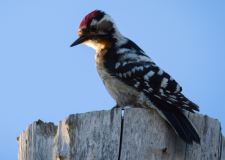
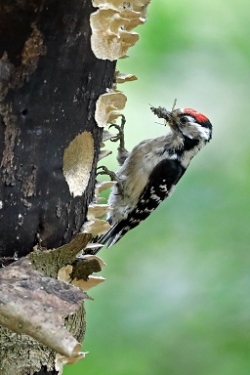
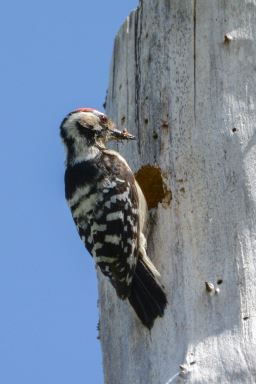
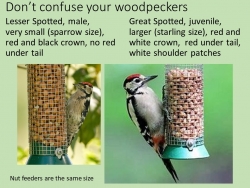
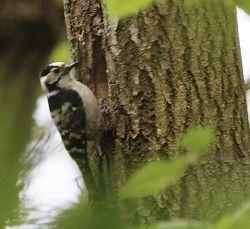
From now until early June is the time to look for Lesser Spotted Woodpecker nests. Adults are actively feeding their young, so become more detectable. Our volunteers have located 11 potential nest sites so far and we have the number of eggs or young for 4 nests.
We are optimistic for this nesting season. Good breeding success in 2025 and sustained efforts with passive sound recorders this spring have identified LSW in many more woodlands than previously thought.
LesserSpotNet volunteers have identified potential nests in Devon, Somerset, the New Forest, Sussex, Kent, the Home Counties, Norfolk, Herefordshire and Worcestershire.
As of 4th May the contents of five nests have been viewed. In one nest a clutch of 5 eggs was being incubated, in two nests 5 young were just hatched, and in the fourth 3 young were just hatched with 3 eggs waiting. In all cases both adults were in attendance both before and after the nest inspection. The other nest cavity had been abandoned.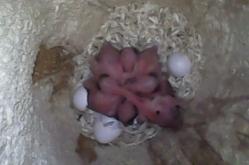 LSW nest cavity with 5 chicks just hatched. Photo Gus Robin & Ed HorncastleWe hope more nests will be found and monitored over the next 4 weeks. If you find a nest, please gather as much information as you can by observing the nest. The information we need is listed below. Please also let Woodpecker Network know what you have found and one of the regional co-ordinators may be able to visit with a nest inspection camera to get information on the numbers of chicks fledged.
Nest observations for Lesser Spotted Woodpeckers - this is the information we need please.
Now we are into the season for finding LSW nests we thought it would be useful to set down the information we are hoping to collect for each nest. This is very much a wish list. It may not be feasible to collect all this information at every nest. Much depends on the local circumstances and when the nest is first found.
Timing of nest visits/nest inspections
At this time of year, we are always trying to work out when we should plan to start inspecting nests or searching for them. It is looking like this year will be yet another warm spring so the data on laying and fledging dates from 2025 will be a useful guide. Don't hang about, in four weeks time it will be all over.
| 2025 | Average, | Range, |
| Date of first egg, | 25 April | 16 April - 5 May |
| Hatching | 10 May | 1 May - 20 May |
| Fledging | 30 May | 21 May - 9 June |
There are obviously other signs that the birds may have completed excavation and are incubating but these data suggest that to get the clutch size for early nests we should plan an inspection before the end of April.
This table is also a useful guide for when to search for nests with noisy young (10+ days old) which is mid to late May.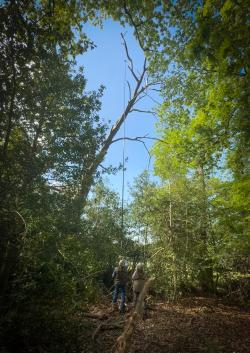 Ken & Linda Smith using the nest camera on telescopic poles to view inside a nest cavity in the tree top at a height of about 17 metresThe nest site
• Location (grid ref or equivalent)
• Tree species, alive or dead
• Tree size – trunk circumference or diameter at breast height (dbh)
• Hole height (m) and orientation of the entrance hole (S, SE etc)
• Nest in the trunk or a side limb
• Distance of nest from any wet feature (river, stream, pond)
• An image of the general environs of the nest
The nesting cycle
Record all your nest visit dates and times and what was seen so we know:
• Date when the nest was first found and what stage – excavating, incubating, feeding young
• First egg date (FED) inferred from the nest observations and the average duration of incubation and chick rearing
• Number of eggs in the clutch (using nest inspection camera when possible)
• Number of young fledged (count of large young using nest inspection camera)
• Date when young fledged.
• For any failed nests record the circumstances and possible cause of failure
Feeding observations
If you have the opportunity carry out nest watches whilst the birds are feeding young. Depending on the visit rate you may need to watch for 30-60mins. Record:
• The date, start and end time of your observation period
• Time of each feeding visit
• Whether it was the male or female
• If possible, do a watch early, midway and late in the chick rearing
Photographs of the birds, but take care not to cause any disturbance or draw attention to the nest.
Please send all the information to Woodpecker Network